
Eco-System System Design
0 - Introduction
This documentation describes a system that establishes a framework for creatures' behaviours within the ecosystem. This system aims for consistency, enabling the player to understand and explore more of the organic variations and predict the location or behaviour of the creatures.
0.1 - Disclaimer
In this document, the names and examples used are for illustrative purposes only; they are not creatures or anything else that are designed for this game. This is a living document, and any specifics pertaining to the mechanics, numbers, and more are subject to change. The assignee of this task is free to apply any values, effects, and other unspecified elements, or contact @Adam Janus or @Utku Dagli to get further guidelines.
0.2 - Terminology
| Term | Meaning |
|---|---|
| PC | Player Character |
| NPC | Non-Playable Character |
| Micro-Zone | Invisible spawn region, within a biome tied to terrain function |
| State Machine | A system for managing the creature's behaviour through states |
| Behavioural State | Current behavioural state of the creature |
1 - System Architecture
This system operates on four interconnected layers. Each layer builds upon the previous layer.
- Layer 1: Creature State Machine
- Layer 2: Micro-Zoning
- Layer 3: Interaction Chains
- Layer 4: Environmental Traces
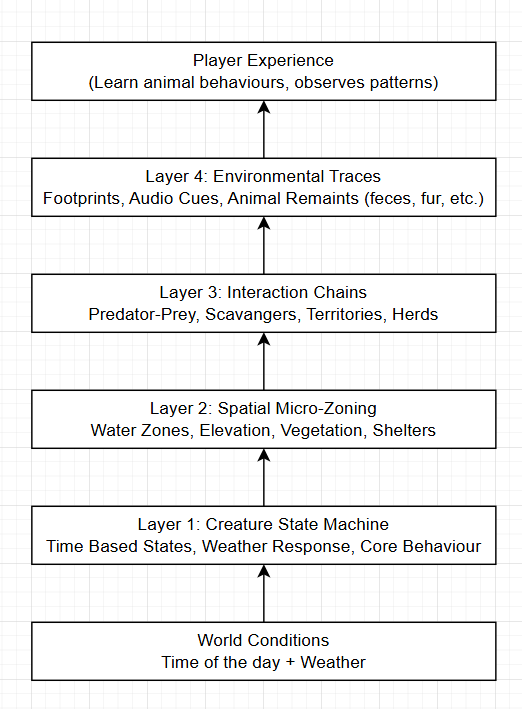
1.1 - Layer 1: Creature State Machine
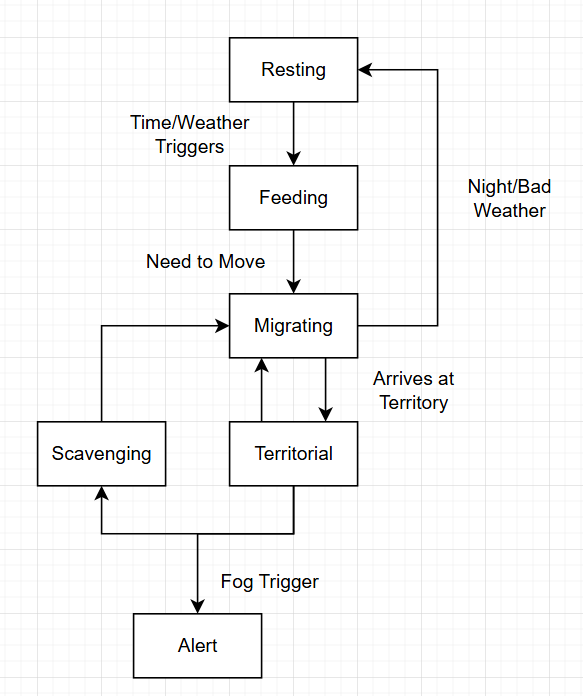
Core Concept: Each creature type behaves differently under specific conditions and states, depending on what those states dictate. For now, they are categorised into three groups (prey, predators and scavengers). In the future, changes could include additions and updates to these documents. These creatures’ behaviour varies under observable conditions, such as day and weather cycles.
1.1.1 - Core States
| State | Characteristics |
|---|---|
| Resting |
|
| Feeding |
|
| Migrating |
|
| Territorial |
|
| Scavenging |
|
| Alert |
|
| Flee |
|
State Transition Diagram
| Creature Type | Morning | Midday | Dusk | Night | Primary Location |
|---|---|---|---|---|---|
| Predator | Resting | Feeding | Feeding | Feeding | Caves → Open areas |
| Prey | Feeding | Resting | Feeding | Resting | Water → Open Areas →Shelter |
| Scavangers | Scavanging | Resting | Scavanging | Resting | Kill Sites → Trees → Caves |
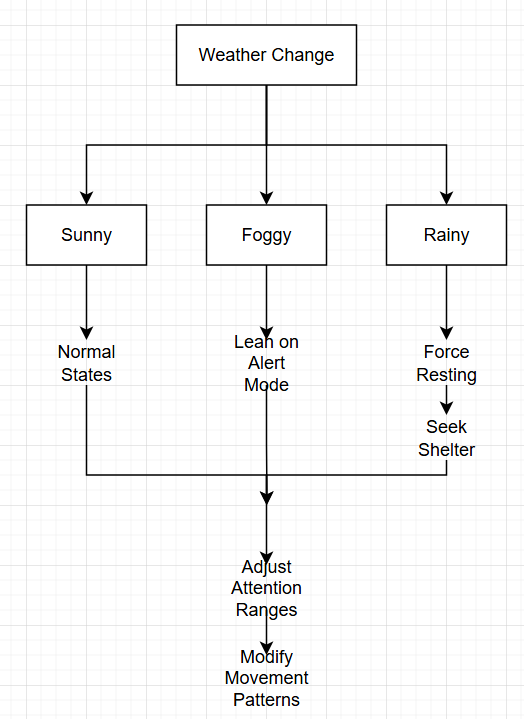
1.1.2 - Weather System
| Weather | Characteristics | ||||||||||||||||||||||||||||||||||||||||||||||||||||||||||||||||||||||||||||||||||||
|---|---|---|---|---|---|---|---|---|---|---|---|---|---|---|---|---|---|---|---|---|---|---|---|---|---|---|---|---|---|---|---|---|---|---|---|---|---|---|---|---|---|---|---|---|---|---|---|---|---|---|---|---|---|---|---|---|---|---|---|---|---|---|---|---|---|---|---|---|---|---|---|---|---|---|---|---|---|---|---|---|---|---|---|---|---|
| Sunny (Baseline) |
| ||||||||||||||||||||||||||||||||||||||||||||||||||||||||||||||||||||||||||||||||||||
| Rainy |
| ||||||||||||||||||||||||||||||||||||||||||||||||||||||||||||||||||||||||||||||||||||
| Foggy |
1.2 - Layer 2: Micro-zoningCore Concept: Within each biome, there are special micro-zones that determine the creature density and spawn priority. These zones are tied to terrain features.
1.2.1 - Micro-zone types
1.3 - Layer 3: Interaction Chains
|
| Time: 0 | Kill Occurs |
| Sunny Weather | 5 mins: Scavenger arrives |
| Foggy Weather | 7 mins: Scavenger arrives |
| Rainy Weather | 10 mins: Scavenger arrives |
| If the carcass is scavenged | The carcass turns to bones, and the bones despawn in 5 minutes |
| Time: 20+ mins | Carcass despawns if not scavenged |
1.4 - Layer 4: Environmental Traces
1.4.1 - Physical Traces Timeline
Core Concept: Creatures leave observable traces behind for their presence and movement. Players can observe these traces to predict the creatures' locations or movements.
Sunny: 8 minutes
- 0 min: 100% visibility.
- 2 mins: 75% visibility
- 4 mins: 50% visibility
- 6 mins: 25% visibility
- 8 mins: Faded
Rainy: 3 minutes
- 0 min: 100% visibility
- 1 min: 50% visibility
- 2 min: 20% visibility
- 3 min: washed away
Foggy: 15 minutes
- 0 min: 100% visibility
- 5 mins: 65% visibility
- 10 mins: 33% visibility
- 15 mins: Faded
1.4.2 - Audio Range by Weather
Audio Detection Comparison:
- Sunny: Source —-------------------> Player
100m
- Rainy: Source —-------------------> Player
60m
Muffled by rain
- Foggy: Source —-------------------> Player
150m
Echo Effect, harder to pinpoint
Audio Range Table
| Weather | Base Range | Modifier | Effective Range | Directionality | Player Strategy |
|---|---|---|---|---|---|
| Sunny | 100m | 1.0x | 100m | Clear | Accurate tracking |
| Rainy | 100m | 0.6x | 60m | Muffled | Close-range only |
| Foggy | 100m | 1.5x | 150m | Echoing | Wide area search |
1.4. - Environmental Disturbance Types
- Crushed grass: When the creature walks on grass or in a wheat field, it crushes the grass or wheat, indicating its presence.
- Broken branches: When the creature walks on a tree branch on the ground or near a tree, or breaks a branch, this indicates the creature is nearby.
- Disturbed water: Indicates the creature is passing by, or drank a couple of seconds ago, or is still drinking.
- Mud Tracks: Footprints will spawn on rainy days, and the water will fill them. Due to that, the fresh tracks will last longer. But in the following rain, if the footprints are still alive, they will start to fade away, as explained in 2.4.1
- Claw Marks: Claw marks indicate that a predator is nearby.
2 - Teaching the System
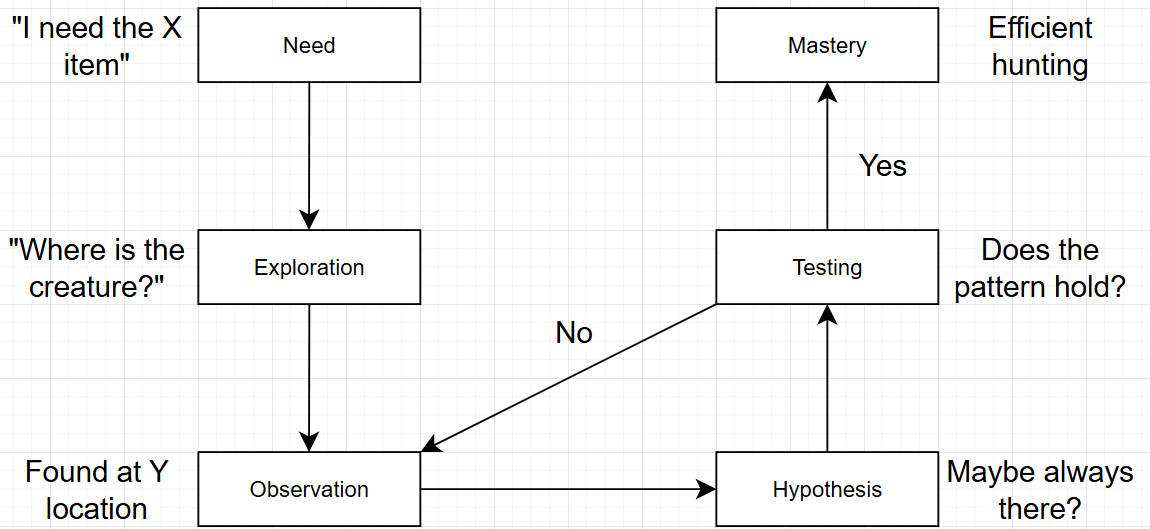
An essential aspect of this concept is that players should never be instructed or told how to hunt or find creatures. The player should learn this system while observing creature behaviours and patterns. Depending on the player types, there may be multiple hints to guide players in the right direction.
Player Types
- Explorer
- Discovers through wandering
- Needs environmental clues
- Achievers
- Challengers are more beneficial
- Needs quests
- Socialisers
- Learns from the NPC
- Benefits from community knowledge
2.1 - Learning Through Natural Gameplay Loop
2.2 - Creature Behaviour Complexity Progression
This section explains the creature behaviours, and to convey the progression to the player, I designed the complexity increase through zone changes. However, when the player reaches the next zone, and its complexity increases, the previous zone's complexity increases as well.
At Zone 1
- Creatures have more predictable behaviours.
- Creatures make more noise.
- They can be found in more predictable locations, such as openings, along waterways, cave entrances or near bushes.
- They react less to the weather conditions.
- Visual and auditory detection ranges 50% lower than base conditions. As a result, 50% fewer triggers in the flee state.
From Zone 2 to 4
- Creatures have less predictable behaviour.
- Creatures make less noise.
- They can be found in less predictable locations and are more likely to migrate between micro-zones or to areas close to their nests.
- Creatures will interact more frequently with one another.
- They fully respond to weather conditions.
- Visual and auditory detection ranges 30% lower than base conditions. As a result, 30% fewer triggers in the flee state.
From Zone 5 to 6
- Creatures have less predictable behaviour.
- Creatures will fully interact with each other.
- Visual and auditory detection ranges 10% lower than base conditions. As a result, 10% fewer triggers in the flee state.
From Zone 7 to 8
- Every behaviour will be in the base conditions, as explained in the previous section.
Design Notes
- Instead of zones, playing time could be used to set the complexity progression.
- Instead of zones, experience level could be used to set the complexity progression.
2.3 - NPC Dialogue with Subtle Hints
Hint Types
- Weather: NPC explains the creature's behaviours during the weather changes between texts.
- Hunter Wisdom: NPC gives subtle hints on prey behaviour and patterns.
- Old Tales: Tells old tales that caution the player on scavenger and predator behaviour and patterns.
- Self Thought: The PC that talks by itself with the observations depending on the pattern findings.
2.4 - Quest Design for Teaching
Teaching quest sequence examples
- Q1 - Teaches: Location of the creatures and what they do during a specific time frame.
- Q2 - Teaches: Creatures' behaviour during the weather changes.
- Q3 - Teaches: Creatures’ audio cues
- Q4 - Teaches: Environmental traces left by creatures.
- Q5 - Teaches: Creature interactions with each other.